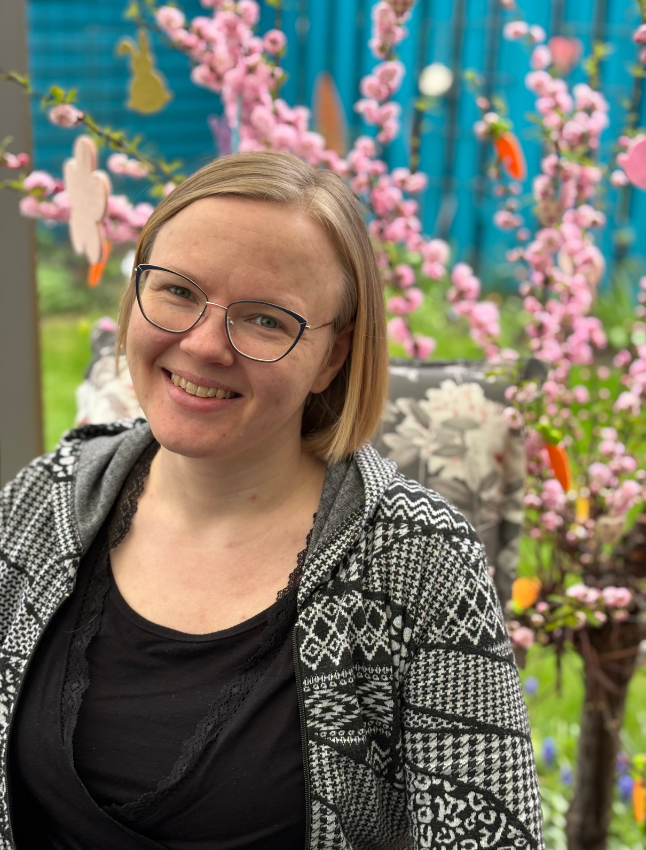
Sarah Kofman
The true art of living consists in seeing the wonderful in everyday things.– Bertha Eckstein
As a native of Schleswig-Holstein, I love the wide sky above the marshes – for me, it is both an inspiration and a source of tranquility. I began drawing as a child, driven by a childish ambition to emulate my older sister. Later, through anime and manga, I discovered my passion for the human body – the beginning of my portrait painting today.
Free portraits are at the core of my artistic work. Faces without a model, yet full of their own stories. They arise intuitively, in a dialogue between feeling and memory. This is how figures develop that seem both familiar and foreign – mirrors of human experiences, desires, and contradictions.
An important technical turning point was a landscape painting course based on Bob Ross, which sparked my enthusiasm for oil painting. Today I work with oil, acrylic, oil pastel, watercolor, papier-mâché, colored pencil, charcoal, ink, pencil, and much more. I find my motifs in nature—in people, animals, and landscapes, but also in social issues that move me.
The thematic focus of my art has changed profoundly since the birth of my daughter. I have come to understand that art must be more than just a craft for me—it is my means of taking responsibility. Since then, I have seen my work as part of a larger task: using art to create visibility for what otherwise remains in the shadows – discrimination, social injustice, environmental destruction. I want to touch, provoke, and give food for thought.
After the death of my stepmother, Ingrid Günther, it is a matter close to my heart to keep her artistic legacy alive in my work. I have completed some of her unfinished paintings in my own style – as a sign of gratitude and connection.
For me, art means not simply accepting the world, but constantly questioning it – with empathy, vulnerability, and hope.
On Instagram and LinkedIn, I share insights into my current work, thoughts, and processes.
Artistic Background
- Born in 1988 in Hamburg
- Drawing since early childhood
- Realistic drawing course at VHS Elmshorn, 2009
- Two alla prima painting courses with artist Rose Adrian-Trienen, 2018 and 2020
- Participating in workshops at Kunsthaus Schenefeld led by Siegrun Roemmling since 2023
Exhibitions
- March 2024: “Silhouettes by the Sea” at Forum Baltikum Dittchenbühne e.V., Elmshorn (group exhibition with artist Ingrid Günther)
- February 2025: “Silhouettes by the Sea” at Barmstedt Town Hall (group exhibition with Ingrid Günther)
- November 2025: “Silhouettes by the Sea” at Forum Baltikum Dittchenbühne e.V., Elmshorn (group exhibition with Ingrid Günther)
Awards
- Finalist Award, Galerie Teravarna, November 2025
- Honourable mention from the Megalopolitan Art Gallery for ‘Girl with a Hood’, May 2026
As a native of Schleswig-Holstein, I love the wide sky above the marshes – for me, it is both an inspiration and a source of tranquility. I began drawing as a child, driven by a childish ambition to emulate my older sister. Later, through anime and manga, I discovered my passion for the human body – the beginning of my portrait painting today.
Free portraits are at the core of my artistic work. Faces without a model, yet full of their own stories. They arise intuitively, in a dialogue between feeling and memory. This is how figures develop that seem both familiar and foreign – mirrors of human experiences, desires, and contradictions.
An important technical turning point was a landscape painting course based on Bob Ross, which sparked my enthusiasm for oil painting. Today I work with oil, acrylic, oil pastel, watercolor, papier-mâché, colored pencil, charcoal, ink, pencil, and much more. I find my motifs in nature—in people, animals, and landscapes, but also in social issues that move me.
The thematic focus of my art has changed profoundly since the birth of my daughter. I have come to understand that art must be more than just a craft for me—it is my means of taking responsibility. Since then, I have seen my work as part of a larger task: using art to create visibility for what otherwise remains in the shadows – discrimination, social injustice, environmental destruction. I want to touch, provoke, and give food for thought.
After the death of my stepmother, Ingrid Günther, it is a matter close to my heart to keep her artistic legacy alive in my work. I have completed some of her unfinished paintings in my own style – as a sign of gratitude and connection.
For me, art means not simply accepting the world, but constantly questioning it – with empathy, vulnerability, and hope.
On Instagram and LinkedIn, I share insights into my current work, thoughts, and processes.
The true art of living consists in seeing the wonderful in everyday things.– Bertha Eckstein
Artistic Background
- Born in 1988 in Hamburg
- Drawing since early childhood
- Realistic drawing course at VHS Elmshorn, 2009
- Two alla prima painting courses with artist Rose Adrian-Trienen, 2018 and 2020
- Participating in workshops at Kunsthaus Schenefeld led by Siegrun Roemmling since 2023
Exhibitions
- March 2024: “Silhouettes by the Sea” at Forum Baltikum Dittchenbühne e.V., Elmshorn (group exhibition with artist Ingrid Günther)
- February 2025: “Silhouettes by the Sea” at Barmstedt Town Hall (group exhibition with Ingrid Günther)
- November 2025: “Silhouettes by the Sea” at Forum Baltikum Dittchenbühne e.V., Elmshorn (group exhibition with Ingrid Günther)
Awards
- Finalist Award, Galerie Teravarna, November 2025
- Honourable mention from the Megalopolitan Art Gallery for ‘Girl with a Hood’, May 2026